The idea of a Basic Income dates back to Thomas Paine, an American revolutionary. In the last few years it has become fashionable among liberals and conservaties. An unconditional basic income grants every citizen an income independent of their personal situation. It is time to eliminate absolute poverty by paying everybody in the world a basic income of US$ 1.90 a day. We can afford it and it will pay back for itself within a generation.
The American novelist Scott Fitzgerald is supposed to have said once to Ernest Hemingway, 'You know, the rich are different from you and me.' Hemingway replied, 'Yes. They've got more money.' It's similar with poor people. They are different because they have less money. The most straight forward way to make poor people less poor is to give them money.
That is not how foreign aid has worked so far. There's also little evidence that foreign aid helps. Despite this failing approach in sending help, we've done a remarkable job reducing global poverty.
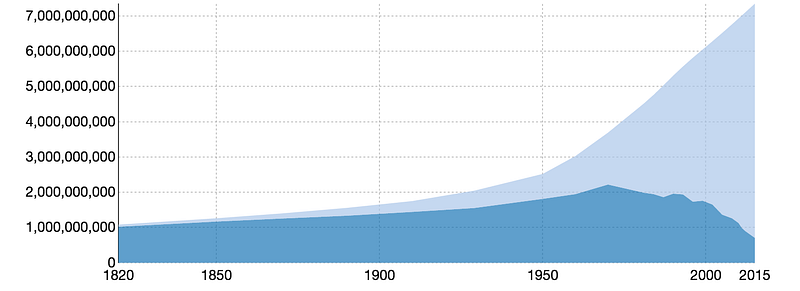
source: https://ourworldindata.org/grapher/world-population-in-extreme-poverty-absolute
This graph shows the growth of the world population and how many people live in absolute poverty, defined as living on less than US$ 1.90 per day, corrected for inflation and local prices. It puts to rest any notion that over-population causes poverty, as some think. Remarkably, there were about 1 billion poor people in 1820 and in 2010. But in 1820 there were 60 million non-poor people. The non-poor population of the world in 2010 was 100 times that. 100 times!
Lifting the final half a billion out of poverty will be tough though. Neither traditional foreign aid, giving live stock, nor micro finance does seem to help. Hence my Hemingway styled plan: if you want to make sure that nobody lives on less than US$ 1.90 a day, give everybody US$ 1.90 a day.
What objections could anybody have against this approach?
You can't trust the poor with money
That's maybe a crude way of putting it, but I think the sentiment is widely shared. Don't give people fish, teach them how to fish! Let's drill wells rather than hand out money that will be spent on water. Give live-stock, not food!
It seems patronizing to think that we know better what the poor need than they do themselves. It's maybe even more than that. The poor people in Africa don't realize that a better life starts with clean water, so we'll fix that for them.
It is quite absurd that we base our economic models on the theory of the rational consumer, yet deny the very poorest their rationality. Surely, the less money you have, the more carefully you'll consider what to spend it on?
Don't take my word for it. The brilliant GiveDirectly has been giving money directly for a while now. The Innovations for Poverty Action people then came in and did a randomized evaluation to find out what the impact was. They found that people do not spend free cash on tobacco or alcohol, but on health, education and investments.
It seems clear to me that the impact on people who live below the absolute poverty line will be even larger. Being poor is expensive, which creates a terrible poverty trap. When you can't afford to go to a doctor, feed yourself or invest in, say, a decent stove, it is hard to escape poverty. If you can't afford school fees, a nutritious breakfast for your children or even to not have your children work beside you, the next generation will remain just as poor.
A basic income for the world is not just charity. It is an escape hatch for the bottom billion. After one generation, we might not even need it. Reaganomics reasoned that increased incomes at the top would trickle down to all of society. That did not pan out. Trickle up though, sounds much more convincing. A 5% increase of world GDP is all that it takes for this program to pay for itself.
It can't be done
Ok, so it's a good idea to give money to the poor, but can this plan be implemented? How do you transfer money to all people in the world when it is hard enough to send money within the US? Sending money through governments is a sure way of it getting lost.
Technology to the rescue. M-Pesa has been offering a way to get money to the African unbanked since 2005. It does not even require a smart phone. India has been rolling out a massive program to get all citizens registered and get them all a bank account. Brazil's Bolsa Família plan provides all poor families with a citizen's card that allows for minimal banking services.
Nowadays, setting up a payment system from scratch is easier than speeding up a creaking legacy system. In Thailand you can pay your gas bill and get a text message confirmation from the gas company within one minute. In the US people still fumble with paper cheques.
Having a banking like system in place that allows for direct transfers is a good idea in any case. Requiring receiver countries to have one helps with a gradual roll out. The system expands as more states adopt modern banking practices.
It's completely unaffordable!
If giving money to the poor is a good idea and we can implement the scheme, can we afford this massive transfer? Some quick calculations:
We have roughly 7 billion people on the planet. Paying each of them US$ 1.90 per day, costs a bit over 13 billion a day, or roughly 4.8 trillion dollars a year. By most standards that is a lot of money. But we're not a poor planet. Total GDP (PPP) stands at 105 trillion. So we'd need a 4.6% tax on everything.
If that still sounds expensive, remember everybody gets the basic income. So if you make less than 1.90 / 4.6%, you get more out of this program than you pay in. This works out to roughly US$ 15 000 a year, which incidentally is about the global, average income per person.
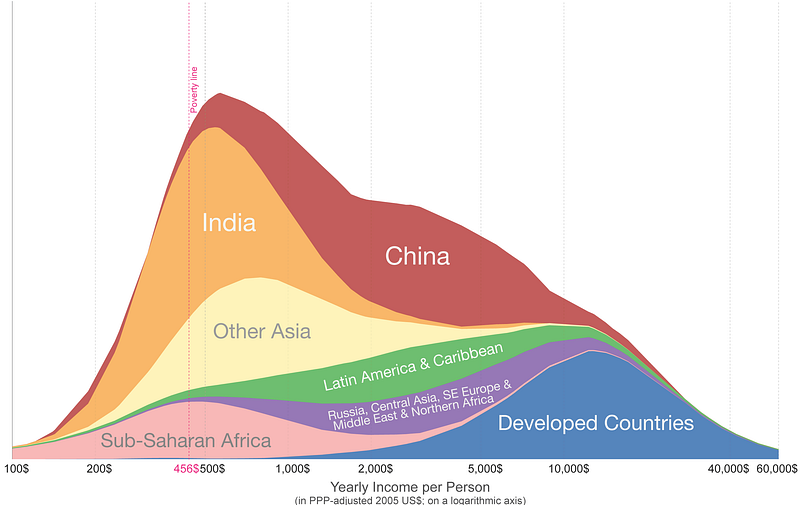
Source: https://ourworldindata.org/VisualHistoryOf/Poverty.html#/title-slide
It gets better than that. These calculations are all done on a purchasing power parity basis. In most poor countries prices are lower than average and so we need less than US$ 1.90 to escape absolute poverty. This makes quite the difference. Life is 74% cheaper in India than in the US. With 20% of all poor people living in India, this makes quite a difference. And it works both ways — Switzerland is expensive and would be a net contributor.
How much of a difference exactly it makes is hard to say, but I estimate around 60%, dropping the tax to 1.9%. For the average American family making US$ 50.000, this would mean US$ 665 a year. For perspective, the average family donates around US$ 2000 to charity.
A global basic income will end absolute poverty in a pragmatic and affordable way. It will even pay for itself within a generation.